
The True Cost of Manual Marketing Work
Manual marketing work is never free — it's a recurring tax paid in labor, errors, latency, and a ceiling on growth. Here's how to price all four and calculate marketing automation ROI accurately.

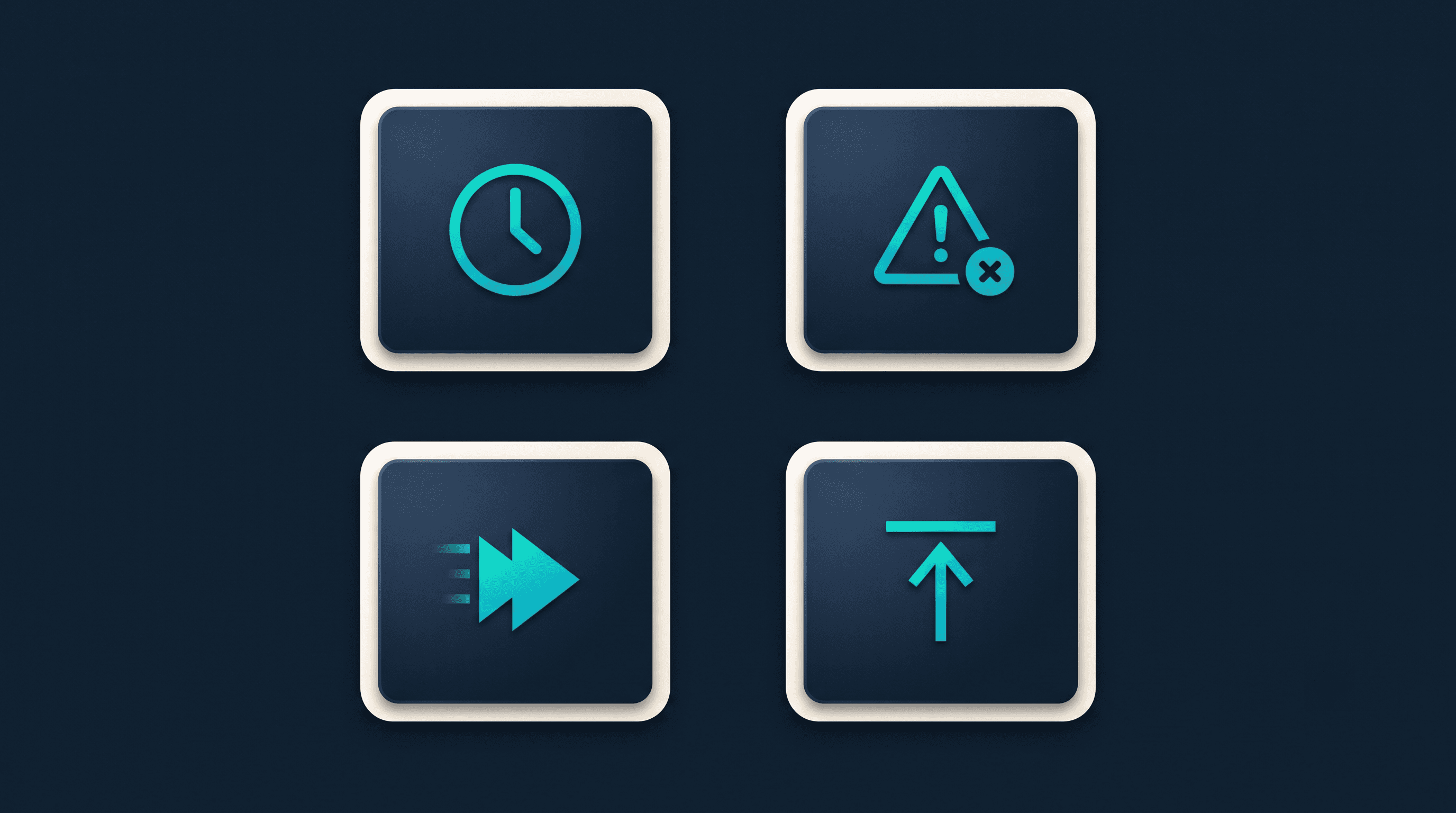
Most service businesses never see the real price of doing marketing by hand. It doesn't show up as a line item. There's no invoice for the two hours a coordinator spent copying leads between a form and a CRM, no charge for the follow-up that went out a day late, no receipt for the deal that quietly went to a competitor who replied first. The cost is real, it's recurring, and it compounds — it's just invisible on a P&L.
That invisibility is the problem. You can't manage a cost you can't see, and you can't justify the investment to remove it. This article gives you a way to make manual marketing cost visible, calculate the return on automating it, and — the part most guides skip — decide which work should stay manual on purpose.
What Marketing Automation ROI Actually Measures
Marketing automation ROI is the return you earn by removing human labor from repeatable marketing work, expressed against the cost of the tools and setup that replace it. The formula is not complicated:
ROI = (Value Gained − Cost of Automation) / Cost of Automation
The difficulty is never the arithmetic. It's the "Value Gained" term. Most operators reduce it to hours saved times an hourly rate, then wonder why the number looks unimpressive. Labor is the smallest part of what manual work costs you. The larger costs — errors, latency, and a hard ceiling on growth — sit off the ledger entirely, which is why automation investments so often get underestimated and deprioritized.

To calculate marketing automation ROI accurately, you have to account for all four costs, not just the one you can timestamp.
The Manual Marketing Tax: Four Costs That Never Hit Your Books
Think of manual marketing work as a tax on every repeatable process in your business. You pay it in four currencies. Naming them is the first step to calculating them.
1. Labor Tax — the hours you can timestamp
This is the obvious one: the person-hours consumed by tasks a machine could run. Pulling reports, scheduling social posts, updating deal stages, sending the same nurture email to a new list. It's the only cost most people count, and it's usually the least expensive of the four. Real, but small.
2. Error Tax — the cost of getting it wrong
Humans doing repetitive work make mistakes at a predictable rate. A mistyped email, a lead assigned to the wrong rep, a segment that got the wrong offer, a report with a broken formula that a client saw before you did. Each error costs rework time, and some cost trust or revenue outright. Manual data entry error rates are well-documented to run in the low single-digit percentages per field — small until you multiply it across every touchpoint and every month. The rate isn't fixed either; it climbs as the same operator tires through the afternoon or hits an unfamiliar format.
3. Latency Tax — the revenue lost to being slow
This is the most expensive currency and the one operators almost never price. When a lead fills out a form and your team responds four hours later instead of four minutes, conversion rate collapses. The foundational research on lead response timing — an MIT and InsideSales.com analysis of more than 15,000 leads — found that the odds of qualifying a lead drop sharply once the response window stretches past the first several minutes; leads contacted within five minutes were far more likely to be qualified than those reached at thirty. Manual work is slow by nature — it waits for a human to be free. Every hour of delay is a discount you're voluntarily giving your competitors.
4. Ceiling Tax — the growth you can't reach
Manual processes scale linearly: more volume requires more people. That means your marketing throughput is capped by headcount, and often by a single person — frequently the founder. The Ceiling Tax is the opportunity cost of every campaign you didn't run, market you didn't test, or lead you didn't work because the humans were already at capacity. It's the largest cost of all and the hardest to see, because you can't miss revenue you never knew was available.
Why this matters: when you calculate ROI using only the Labor Tax, you compare a tool's price against a coordinator's hourly wage and often conclude it's not worth it. When you price all four taxes, the same automation frequently pays for itself on the Latency line alone. The framework's job is to stop you from underbuying because you undercounted.
How Automation Reduces Each Tax
Automation isn't valuable because it's modern. It's valuable because it attacks all four taxes at once. Here's the manual-versus-automated comparison that matters, mapped to the cost it removes:

- Lead intake & CRM updates — Manual reality: Copy-paste from form to CRM, minutes per lead, prone to typos; Automated reality: Lead flows in, enriched and assigned instantly; Tax removed: Labor, Error, Latency
- Lead nurturing — Manual reality: Rep remembers to follow up (or doesn't); Automated reality: Triggered sequence fires on behavior; Tax removed: Latency, Ceiling
- Email campaigns — Manual reality: Built and sent by hand each time; Automated reality: Templated, segmented, scheduled; Tax removed: Labor, Error
- Social scheduling — Manual reality: Posted live, one platform at a time; Automated reality: Queued across channels in batches; Tax removed: Labor, Ceiling
- Reporting — Manual reality: Rebuilt manually each week/month; Automated reality: Live dashboard, always current; Tax removed: Labor, Error
Notice that the highest-value automations — intake and nurturing — are the ones that remove the Latency and Ceiling taxes, not just labor. That's your prioritization signal. Automate where the expensive taxes live, not where the work is merely annoying.
The common mistake here is automating the easy stuff first because it's satisfying to check off. Scheduling social posts feels productive, but it only removes Labor Tax. Automating instant lead response feels harder to set up, but it removes Latency Tax — the currency that actually moves revenue. Sequence by cost removed, not by ease of setup.
Calculating Marketing Automation ROI Accurately
Reporting itself has become the near-default use case for automation — the large majority of marketing teams now lean on automated systems for data analysis and reporting, which is precisely what makes accurate ROI measurement possible in the first place. Here are the metrics that belong in real marketing automation ROI reporting, and how each one maps to a tax:

- Hours saved → Labor Tax. Hours reclaimed × loaded hourly cost (salary plus overhead, not base wage).
- Cost per lead (CPL) → Efficiency. Total spend ÷ leads generated, tracked before and after.
- Conversion rate → Latency Tax. The number that moves most when response time drops.
- Customer acquisition cost (CAC) → Composite. The clearest single number for whether automation is working; it should fall as automation compounds.
- Revenue per employee → Ceiling Tax. The truest measure of leverage — it rises only when your team produces more without growing.
A worked example
The arithmetic is simple once you agree to count more than hours. Illustrative figures, clearly labeled as assumptions:
Before automation
- 10 hours/week on manual marketing tasks at a $40/hr loaded cost = $400/week → ~$20,800/year (Labor Tax)
- Average 3-hour lead response time; 8% lead-to-customer conversion
- 100 leads/month → 8 customers
After automation
- Tool + setup cost: $300/month = $3,600/year
- 8 of 10 weekly hours reclaimed = ~$16,600/year in Labor Tax recovered
- Instant lead response lifts conversion from 8% to 12% (a conservative Latency Tax recovery)
- Same 100 leads/month → 12 customers
The ROI calculation
- If each customer is worth $500, the 4 extra customers/month = $24,000/year in new revenue (Latency Tax recovered)
- Total value gained: ~$16,600 (labor) + $24,000 (latency) = $40,600
- ROI = ($40,600 − $3,600) / $3,600 = ~10.3x
Run that same example counting only labor, and ROI is ~3.6x — still positive, but less than half the real figure, and easy to talk yourself out of. The Latency line is where the return actually lives. This is the single most common reason accurate ROI calculations diverge from back-of-napkin ones.
When Manual Marketing Still Wins
Automation is a labor-removal tool, not a strategy. Some marketing work should stay human on purpose, and treating everything as a candidate for automation is its own expensive mistake.
Use a simple test: keep it manual when the work is high-judgment, high-trust, or genuinely one-off. Specifically:
- High-touch relationship moments. The sales conversation that closes a $50k engagement. The apology to a client who had a bad month. Automating these doesn't save money; it signals you don't care.
- Creative and strategic work. Positioning, campaign concepts, the actual message. Automation distributes the message faster — it can't decide what the message should be.
- True personalization. Not "insert first name," but genuine, context-aware outreach that reflects something specific about the recipient. That's a human advantage, and it's worth protecting.
The distinction that resolves most cases: automate the repeatable and rules-based; keep the judgment-based and relational in human hands. If a task follows the same steps every time and doesn't require reading the room, it's paying you the Manual Marketing Tax for no reason. If it changes every time and depends on trust, the human is the product.
Choosing Tools That Actually Deliver Return
The market is crowded and most of it is overkill for a growing service business. Prioritize on the features that map to the expensive taxes:
- Trigger-based workflows (behavior-driven automation) — attacks Latency and Ceiling. Non-negotiable.
- Clean CRM integration — attacks Error and Labor. If the tool doesn't sync cleanly with where your data lives, it creates new manual work instead of removing it.
- Native reporting — attacks Error and makes ROI reporting possible in the first place. If you can't measure it, you can't defend the spend.
- Room to grow without a re-platform in 18 months.
Implementation mistakes that quietly kill ROI
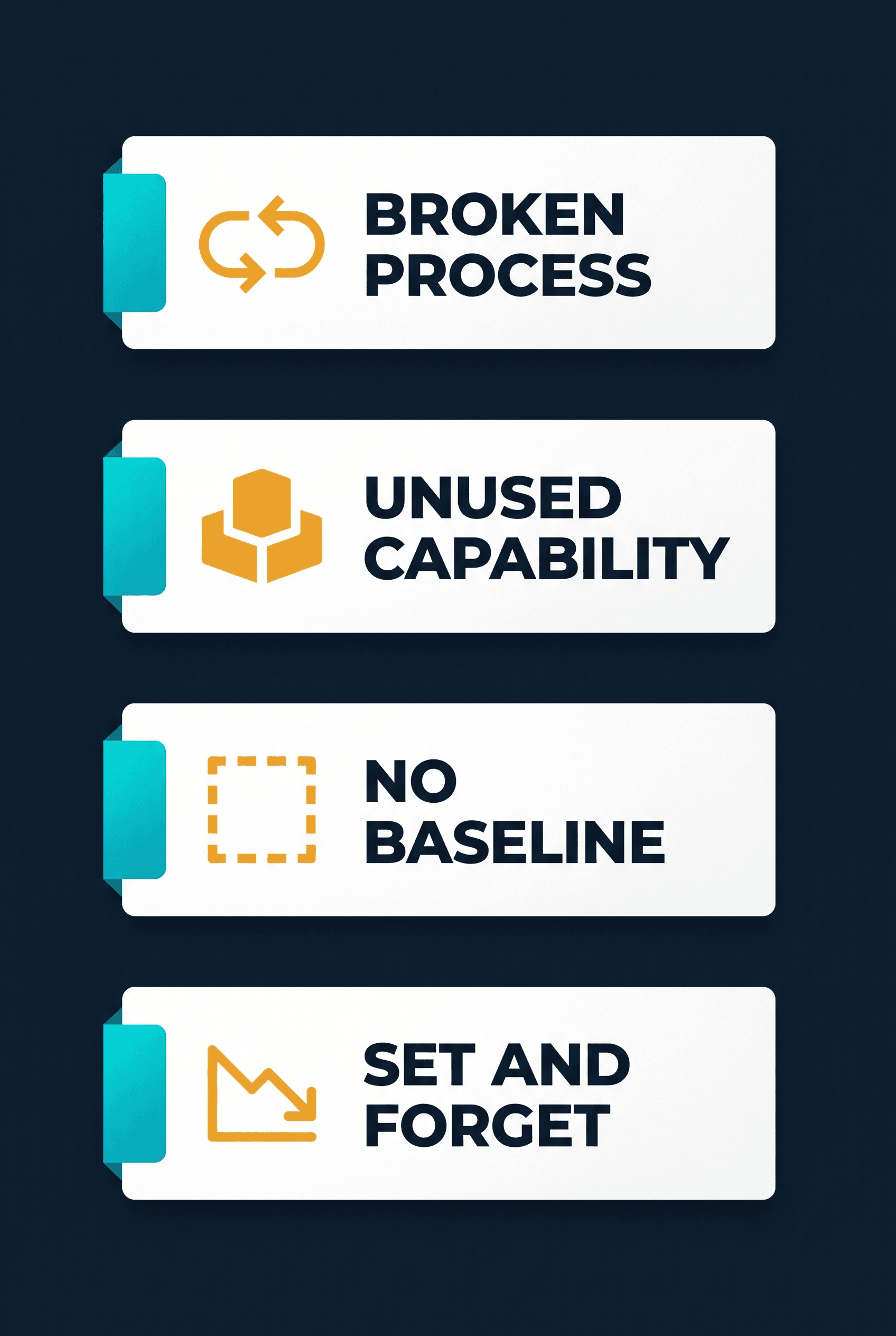
- Automating a broken process. Automation multiplies whatever it runs. A bad workflow, automated, produces bad outcomes faster. Fix the process on paper first, then automate it.
- Buying capability you won't use. The enterprise platform with 200 features you'll never touch has a real cost: complexity, onboarding drag, and a monthly bill against value you never capture. Match the tool to the taxes you're actually paying.
- No measurement baseline. If you don't record CPL, conversion, and CAC before you automate, you can't prove the return afterward. Capture the baseline first — it's the cheapest step and the one everyone skips.
- Set-and-forget. Automated workflows drift. Sequences go stale, triggers break, segments rot. Return compounds only if someone owns the system and reviews it.
The tip that maximizes long-term value is unglamorous: treat automation as a system you maintain, not a tool you buy. The businesses that get 10x returns aren't the ones with the best software. They're the ones that mapped their taxes, automated the expensive ones first, measured the baseline, and kept the system tuned.
The Bottom Line
Manual marketing work is never free — it's a recurring tax paid in labor, errors, latency, and a ceiling on your growth. Most operators only count the first and conclude automation isn't worth it. Price all four, and the math almost always flips. Calculate your ROI honestly, automate where the expensive taxes live, and deliberately keep the high-judgment work human. That's the difference between buying software and building leverage.
- Marketing Automation ROI
- Manual Marketing
- Automation
- Lead Response
- Cost Per Lead
- CAC
- Marketing Operations