
Creating a Content Calendar: How-To, Guides & Templates


A content calendar is one of the simplest tools in marketing, yet it’s often the dividing line between content programs that create business value and those that generate activity without results.
Many businesses treat content as a series of isolated tasks: write a blog post, publish a social update, send an email, repeat. The problem isn’t effort—it’s the lack of a system connecting content creation to business goals.
A content calendar provides that system. It transforms content from reactive publishing into strategic planning.
Whether you’re a small business owner managing marketing yourself or a content creator trying to stay consistent, a well-structured content calendar helps you publish with purpose, improve efficiency, and create measurable outcomes.
What Is a Content Calendar?
A content calendar is a planning framework that organizes content production and publication across specific dates, channels, audiences, and objectives.
At its most basic, it answers five questions:
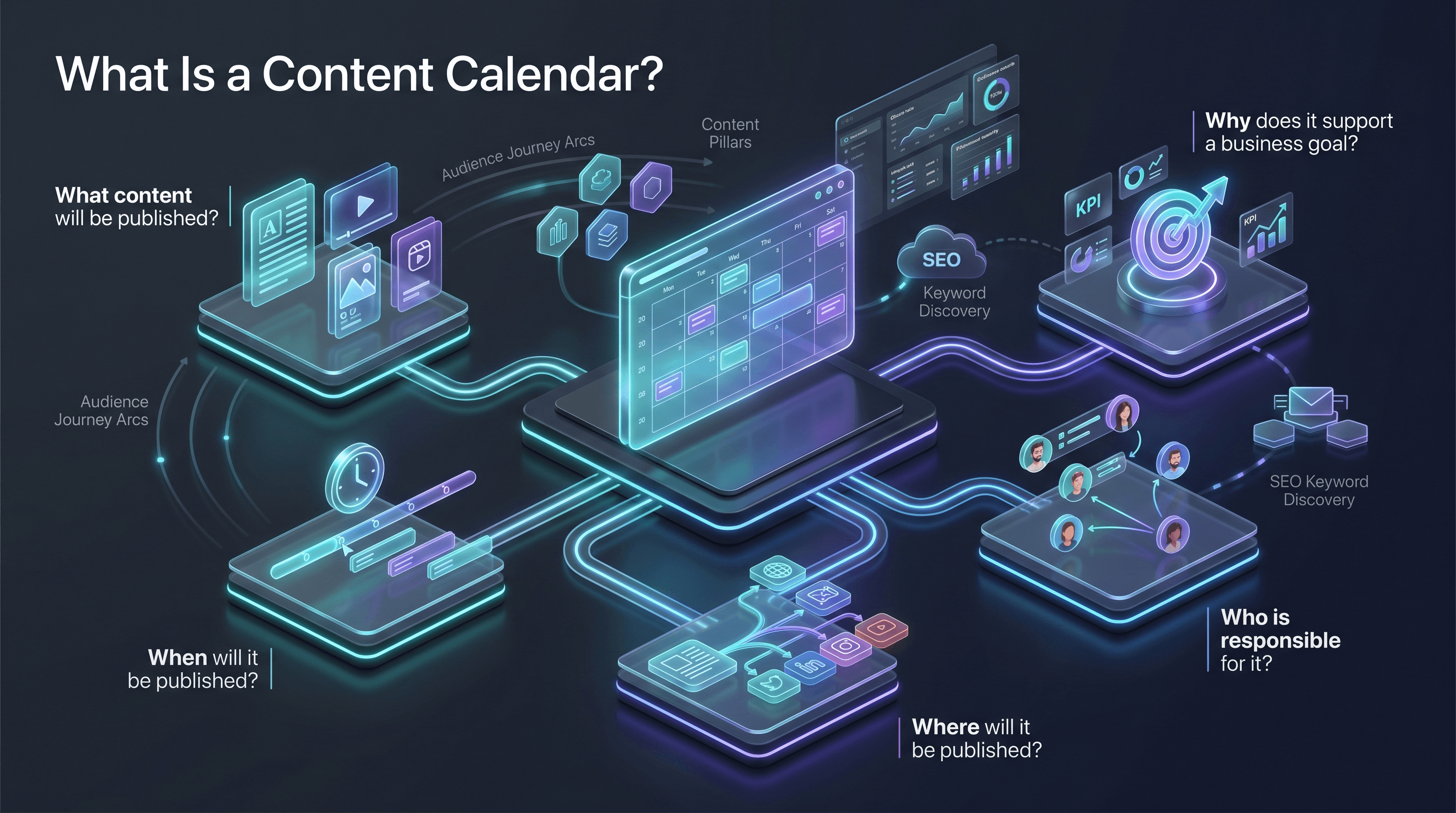
- What content will be published?
- When will it be published?
- Where will it be published?
- Who is responsible for it?
- Why does it support a business goal?
A content calendar can exist in a spreadsheet, project management platform, editorial software, or social media scheduling tool. The format matters less than the process behind it.
The goal is not simply to schedule content. The goal is to create a repeatable system that connects marketing efforts to business outcomes.
Why Every Business Needs a Content Calendar
Benefits of Content Planning
Without a plan, content decisions are often driven by urgency rather than strategy.
A content calendar shifts the focus from “What should we post today?” to “What content moves our business forward this quarter?”
This creates stronger alignment between content production and company objectives.
Improving Consistency and Publishing Frequency
Consistency is one of the strongest predictors of long-term content performance.
Businesses that publish sporadically often struggle to build audience trust, search visibility, or engagement momentum.
A content calendar creates accountability and ensures content continues moving through production regardless of day-to-day distractions.
Aligning Content with Business Goals
Every content asset should support a specific objective. A calendar helps prevent random content creation by ensuring every piece serves a purpose.
Reducing Last-Minute Content Creation
Reactive content production often leads to:
- Lower-quality content
- Missed deadlines
- Team burnout
- Inconsistent messaging
Planning ahead gives teams time to research, write, review, and optimize content properly.
Enhancing Team Collaboration
Marketing rarely operates in isolation, but happens more often than you think. Content often requires input from subject matter experts, designers, sales teams, product teams, leadership. A centralized content calendar improves visibility and reduces communication bottlenecks.
Tracking Content Performance Over Time
The best content calendars don’t stop at publication dates.
They also track:
- Traffic
- Engagement
- Rankings
- Leads
- Conversions
This transforms the calendar from a planning tool into a performance management system.
The C.A.L.E.N.D.A.R. Framework
Most businesses fail because they focus on scheduling instead of strategy.
A simple framework for building a sustainable content calendar is:
C.A.L.E.N.D.A.R.
C — Clarify business goals
A — Analyze audience needs
L — Launch content pillars
E — Establish publishing cadence
N — Navigate the buyer journey
D — Define workflows and ownership
A — Audit performance regularly
R — Refine based on results
This framework ensures the calendar supports outcomes rather than simply organizing tasks.
How to Build a Content Calendar from Scratch
Defining Content Goals and KPIs
Start with outcomes, not topics.
Examples include:
Goal / KPI
- Increase organic traffic / Organic sessions
- Generate leads / Form submissions
- Improve awareness / Reach and impressions
- Build authority / Backlinks and mentions
- Drive sales / Revenue attribution
When goals are clear, content decisions become easier.
Identifying Your Target Audience
A calendar is only effective if it’s built around audience needs.
Ask:
- What problems are they trying to solve?
- What questions do they ask before buying?
- What objections prevent action?
- What information do they need at each stage?
Audience research prevents content from becoming self-promotional.
Choosing Content Themes and Pillars
Content pillars create structure.
For example, a marketing agency might use:
- SEO
- Paid Advertising
- Marketing Automation
- Analytics
- Content Strategy
Every piece of content should fit within one of these strategic themes.
Mapping Content to the Buyer’s Journey
Different audiences require different content.
Awareness Stage
Topics that answer basic questions.
Example:
- What is a content calendar?
Consideration Stage
Topics that compare solutions.
Example:
- Best content calendar tools
Decision Stage
Topics that support purchasing decisions.
Example:
- How to choose content planning software
A balanced calendar includes all three stages.
Establishing Publishing Frequency
Publishing frequency should be based on capacity, not ambition.
A common mistake is building a content calendar around what a business wants to publish instead of what it can realistically sustain. This usually creates a short burst of activity followed by missed deadlines, rushed work, and inconsistent output.
For most small businesses, consistency is more valuable than aggressive volume. One strong article every week is often more useful than five rushed posts that never get promoted, optimized, or connected to a larger strategy. The same applies to social media. A business that can consistently publish three thoughtful posts per week will usually outperform one that posts daily for two weeks and then disappears for a month.
The right cadence should pass what we can call the Capacity Test:
Can this publishing schedule be maintained for six months without lowering quality, delaying client work, or creating operational stress?
If the answer is no, the schedule is too aggressive.
A practical content calendar should also account for the full lifecycle of content. Publishing is only one step. Research, writing, editing, design, approval, optimization, distribution, and reporting all take time. When businesses ignore those hidden stages, the calendar becomes unrealistic before the first month is finished.
The best approach is to start with a manageable baseline, then increase volume only after the workflow is stable. For example, a small business might begin with two blog posts per month and three social posts per week. Once that rhythm becomes easy to maintain, the team can add email newsletters, short-form video, or additional platform-specific content.
The objective is not to publish as much as possible. It is to build a content system that compounds over time.
Creating a Content Workflow
A content workflow should include:
Topic selection
- Keyword research
- Content creation
- Review and approval
- Design and assets
- Publishing
- Promotion
- Performance reporting
Many businesses think the calendar itself creates consistency -- It does not. The calendar shows what should happen. The workflow determines whether it actually gets done.
A strong content workflow defines how an idea moves from concept to published asset. It should clarify who owns each stage, what approvals are required, where assets are stored, and how performance will be reviewed after publication.
For example, a blog post may begin with keyword research and topic selection. From there, it moves into outlining, drafting, editing, SEO review, design, publishing, internal linking, social promotion, and performance tracking. If no one owns the handoff between these stages, delays are almost guaranteed.
This is especially important for small teams, where one person may be responsible for several roles. A business owner might approve topics, a freelancer might write drafts, a designer might create graphics, and a marketing coordinator might schedule posts. Without a defined workflow, everyone depends on memory, Slack messages, or last-minute reminders.
A good workflow removes ambiguity. Each content item should have a status, an owner, a deadline, and a next action. That simple structure prevents the most common bottleneck in content operations: content that is “almost done” but not actually published.
The workflow should also include a feedback loop. After content is published, someone should review performance and decide what happens next. Should the article be updated? Should it become a social campaign? Should it be expanded into a downloadable guide? Content calendars become much more valuable when they manage content after publication, not just before it.
Spreadsheet-Based Content Calendars
Spreadsheets remain popular because they’re flexible and inexpensive.
Best for:
- Solopreneurs
- Small businesses
- New content programs
Typical columns include:
- Publish date
- Topic
- Keyword
- Channel
- Author
- Status
Project Management Platforms for Content Planning
Tools like Asana, Trello, and ClickUp provide stronger workflow management.
Advantages include:
- Task assignments
- Deadline tracking
- Approval workflows
- Team collaboration
Project management platforms are useful when content requires collaboration. Instead of treating each content asset as a row in a spreadsheet, these tools treat each asset as a task or project. That allows teams to assign owners, set deadlines, attach creative assets, leave comments, and move work through stages such as “Briefed,” “Drafting,” “Editing,” “Approved,” and “Published.”
This matters because content delays rarely happen because the team lacks ideas. They usually happen because ownership is unclear. A draft sits with a reviewer. A graphic is waiting on design. A social caption is not approved. A project management platform makes those bottlenecks visible.
These tools are especially helpful for businesses publishing across multiple channels. A single campaign might include a blog post, email newsletter, landing page, LinkedIn posts, Instagram graphics, and paid ads. Managing that campaign in a basic spreadsheet can quickly become difficult. A project management platform creates a shared operating system for the campaign.
The mistake to avoid is overbuilding the process. Small teams do not need twenty statuses, complex automations, or multi-layer approval flows. The goal is to make content easier to produce, not to create administrative work around the production process.
Social Media Scheduling Tools
A social media content calendar has a slightly different purpose than an editorial calendar.
An editorial calendar usually focuses on planned long-form content such as blog posts, guides, newsletters, and campaigns. A social media content calendar manages publishing frequency, platform mix, creative formats, captions, promotional windows, and engagement timing.
Scheduling tools become useful when a business is managing multiple platforms or posting at a consistent weekly cadence. They allow content to be planned in advance, reviewed before publication, and distributed without requiring someone to manually post every day.
Platforms such as Buffer, Hootsuite, and Sprout Social combine planning with publishing.
How to Plan Content Around SEO Keywords
SEO content planning should not begin with a list of keywords. It should begin with a clear understanding of the audience’s problems, decision process, and search behavior.
Keywords are signals. They show what people are looking for, how they describe their needs, and where they may be in the buying journey. A content calendar turns those signals into a publishing plan.
Conducting Keyword Research
Keyword research helps identify demand, but demand alone is not enough.
A keyword with high search volume may look attractive, but it may not be valuable if the searcher has no buying intent, the competition is too strong, or the topic does not connect to the business. A lower-volume keyword with strong relevance can often produce better results because it attracts a more qualified audience.
The most useful keyword research balances four factors:
- Search Demand
- Intent
- Difficulty
- Business Relevance
Search demand shows whether people are looking for the topic. Intent reveals what they expect to find. Difficulty helps estimate how competitive the topic will be. Business relevance determines whether ranking for the keyword would actually support the company’s goals.
For example, a small business selling marketing services may want to rank for “content calendar template.” That keyword is relevant because someone searching for a template is likely trying to improve their content planning process. If the article provides a useful template and explains how to use it strategically, it can attract the right audience while building trust.
The goal is not to chase keywords. The goal is to identify content opportunities where audience need and business value overlap.
Organizing Keywords Into Topic Clusters
A strong SEO content calendar is organized around topic clusters, not isolated keywords.
A topic cluster connects one broad pillar topic with several supporting articles. The pillar page covers the subject comprehensively, while supporting articles address more specific questions or use cases.
For example, “content calendar” could be the pillar topic. Supporting articles might cover content calendar templates, social media content calendars, editorial calendar examples, SEO content planning, and content workflow management.
This structure helps both readers and search engines understand the relationship between your content. Readers can move from a broad guide to more specific resources. Search engines can see that the site has depth around the topic.
The strategic benefit is compounding authority. Instead of publishing disconnected posts, the business builds a concentrated body of content around a subject it wants to own.
This also improves internal linking. Each supporting article can link back to the main guide, and the main guide can link out to deeper resources. Over time, the entire cluster becomes stronger.
Mapping Keywords to Calendar Dates
Once keywords are organized into clusters, they need to be mapped to the calendar in a logical sequence.
This sequence matters. A business should usually publish foundational content before highly specific supporting content. For example, it makes sense to publish a broad guide to content calendars before publishing narrower pieces about social media content calendars or template customization.
The calendar should also avoid placing too many similar topics too close together. Publishing three articles that all target nearly the same intent can create internal competition and dilute focus. Instead, related topics should be spaced out and connected through internal links.
Keyword mapping also helps balance short-term and long-term opportunities. Some content may target competitive evergreen terms that take time to rank. Other content may target lower-competition questions that can gain traction faster. A healthy SEO calendar includes both.
The calendar should not simply ask, “What keyword are we targeting?” It should ask, “Why this keyword, why now, and how does this piece support the broader content system?”
Balancing Evergreen and Trending Topics
Evergreen content provides the foundation of a content calendar. These are assets that remain useful over time, such as how-to guides, templates, educational articles, and strategic frameworks.
Trending content adds relevance. These pieces respond to current events, platform updates, seasonal behavior, industry conversations, or emerging customer questions.
The mistake many businesses make is relying too heavily on one side.
An all-evergreen calendar can become too static. It may rank over time, but it can miss timely opportunities to join conversations or respond to market shifts. An all-trending calendar can create bursts of attention but often lacks long-term search value.
A strong calendar blends both. Evergreen content builds compounding visibility, while trending content keeps the brand relevant and responsive.
For small businesses, a practical approach is to use evergreen content as the core plan and reserve a portion of the calendar for timely opportunities. That way, the team has structure without becoming rigid.
Avoiding Keyword Cannibalization
Keyword cannibalization happens when multiple pages target the same search intent.
This often occurs when teams plan content one topic at a time without looking at the full calendar. They may create separate articles for “what is a content calendar,” “content calendar guide,” and “content calendar explained,” even though all three could satisfy the same search intent.
The result is internal competition. Instead of one strong page earning authority, several weaker pages compete against each other.
The solution is to map intent before assigning topics. If two keywords represent the same reader need, they should usually be combined into one stronger article. If they represent different needs, they can become separate pieces.
For example, “content calendar template” and “social media content calendar” may overlap, but they are not identical. One searcher may want a planning document. The other may want platform-specific social media guidance. Those could justify separate pieces if each article has a distinct angle.
A content calendar should include a simple cannibalization check before new topics are approved. Before creating a new asset, ask whether an existing article already satisfies the same intent. If it does, updating or expanding the existing article may be more effective than creating something new.
Measuring SEO Performance From Planned Content
SEO performance should be evaluated after content has had enough time to be indexed, ranked, and discovered.
The most useful metrics depend on the goal of the content. For awareness content, organic impressions, rankings, and traffic may matter most. For conversion-focused content, leads, assisted conversions, demo requests, or purchases may be more important.
The key is to connect SEO performance to the original purpose of the content. A blog post targeting top-of-funnel searchers should not be judged only by immediate conversions. A decision-stage article should not be judged only by traffic volume.
This is where the content calendar becomes valuable as a performance tool. By tracking target keyword, publish date, content type, funnel stage, and business goal, the team can review patterns over time.
They may find that template-based content drives more email signups, comparison content supports sales conversations, or educational guides attract organic traffic but need stronger internal links to conversion pages.
The calendar should help answer the question: what should we create more of, improve, consolidate, or stop producing?
Planning Content Across Multiple Platforms
Every platform serves a different purpose.
For example:
Platform / Primary Goal
- LinkedIn / Professional authority
- Instagram / Brand engagement
- Facebook / Community building
- X / Real-time conversations
- YouTube / Long-form education
The same message should be adapted, not duplicated.
Scheduling Posts for Maximum Engagement
Posting frequency matters, but audience behavior matters more.
Use platform analytics to identify:
- Peak engagement times
- High-performing formats
- Audience activity patterns
Schedule accordingly.
Incorporating Seasonal and Trending Topics
Plan for:
- Holidays
- Industry conferences
- Product launches
- Seasonal buying cycles
Adding these events to your calendar months in advance reduces last-minute scrambling.
Repurposing Blog Content for Social Media
Repurposing is one of the highest-leverage uses of a content calendar.
A single blog post can support multiple social posts if the team plans for repurposing from the beginning. A how-to article can become a LinkedIn post explaining the core framework, an Instagram carousel summarizing key steps, a short video addressing one common mistake, and an email newsletter linking back to the full guide.
This does not mean copying the same content into every channel. Effective repurposing translates the idea into the format that works best for each platform.
For example, a blog post about content calendars might produce a social post about why most calendars fail, a carousel showing the planning workflow, a short video explaining how to choose content pillars, and a poll asking business owners what part of planning slows them down most.
The business outcome is efficiency. Instead of constantly creating from scratch, the team extracts more value from each core asset. This improves consistency without multiplying the workload.
Final Thoughts
A content calendar is not valuable because it organizes dates. It is valuable because it creates a system for making better content decisions.
When built well, it helps a business choose the right topics, publish consistently, coordinate teams, support SEO, manage social media, and learn from performance. It reduces the chaos of last-minute content creation and replaces it with a repeatable operating rhythm.
The best content calendars are not the most complicated. They are the ones that connect strategy to execution.