


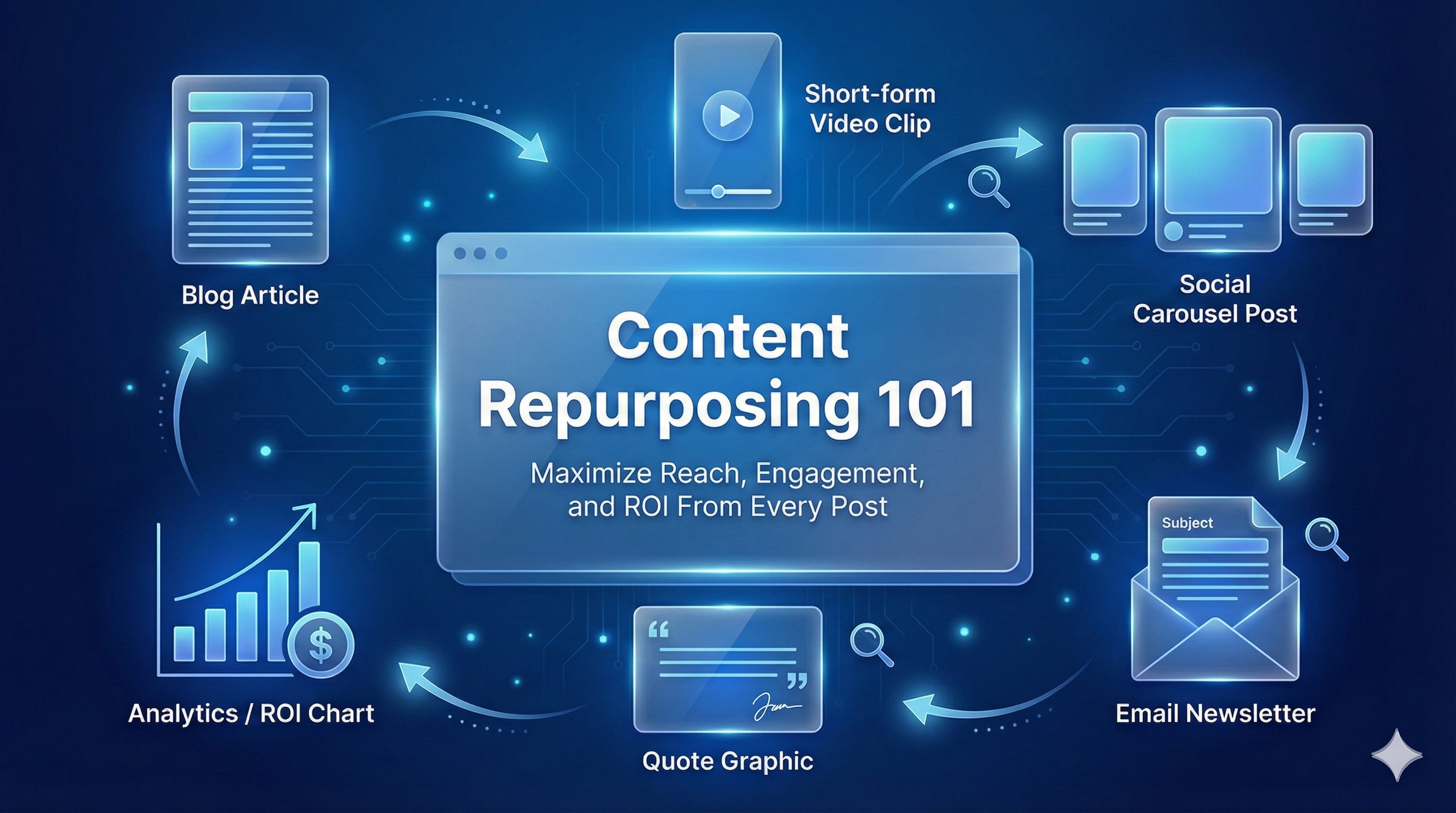
Most businesses don’t have a content problem.
– “They have a distribution and leverage problem.“
Teams invest hours creating blogs, videos, or podcasts—then publish once, promote lightly, and move on. Content repurposing flips that model. Instead of treating content as a single-use asset, you treat it as infrastructure: something designed to be reused, adapted, and compounded over time.
This article breaks down what content repurposing actually is, how to do it strategically (not mechanically), and how to adapt content across blogs, social, video, and email—without burning out your team or diluting quality.
What is Content Repurposing (Really)?
Content repurposing is the practice of transforming a core piece of content into multiple formats, angles, or distributions—each tailored to a specific platform, audience behavior, and intent.
The key word is transforming, not reposting.
Repurposing is not:
- Copy-pasting the same caption across platforms
- Posting blog links everywhere and calling it “distribution”
- Cutting a video into random clips with no narrative arc.
True content repurposing asks a more strategic question:
-“How do we extract the maximum business value from an idea we’ve already proven worth creating?“
When done correctly, repurposing:
- Extends content lifespan
- Increases surface area for discovery
- Improves ROI on time, tools, and creative effort
- Creates message consistency without repetition
Why Content Repurposing Matters More Than Creating New Content
Most teams default to volume because it feels productive. But volume without leverage creates diminishing returns. Content repurposing matters because platforms reward frequency and relevance, while teams are constrained by time and attention. Repurposing is the bridge between those realities.
From a business perspective, repurposing:
- Lowers customer acquisition cost by increasing touchpoints per idea
- Improves brand recall through repeated exposure in different contexts
- Lets you test messaging faster by reframing the same insight
In short: repurposing is how small teams compete with big distribution machines
The CORE Framework: A Practical Model for Repurposing Content
To avoid random or low-quality repurposing, use the CORE Framework:
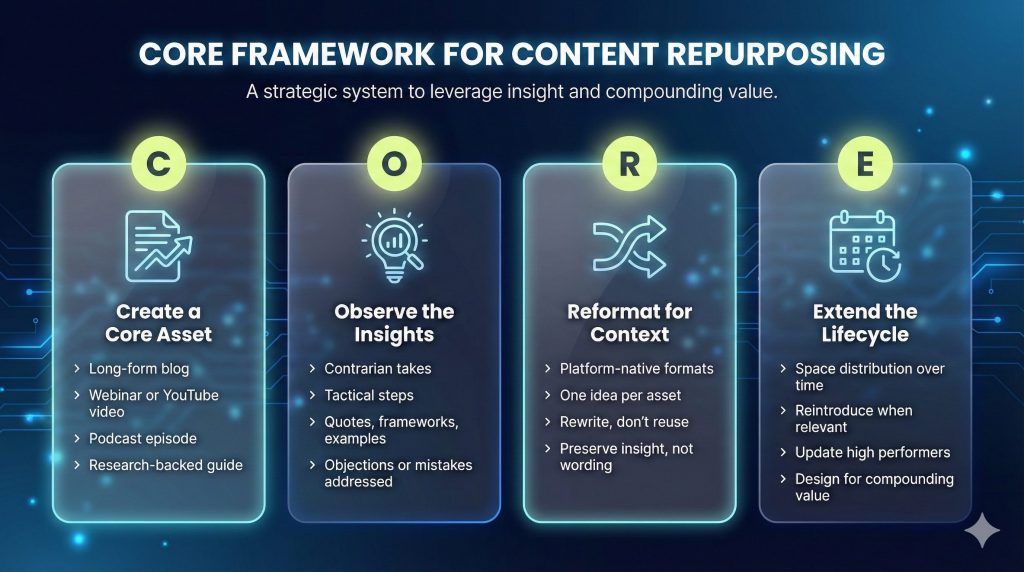
C — Create a Core Asset
Start with one high-signal, durable piece of content:
- A long-form blog
- A webinar or YouTube video
- A podcast episode
- A research-backed post or guide
If the core asset isn’t valuable on its own, repurposing will only amplify mediocrity
O — Observe the Insights
Identify the strongest elements:
- Contrarian takes
- Tactical steps
- Quotes, frameworks, or examples
- Common objections or mistakes addressed
These are your repurposing “atoms.”
R — Reformat for Context
Start with one high-signal, durable piece of content:
- Contrarian takes
- Tactical steps
- Quotes, frameworks, or examples
- Common objections or mistakes addressed
E — Extend the Lifecycle
- Repurposed content shouldn’t all drop in the same week
- Space it out
- Reintroduce ideas when they’re relevant again
- Update and resurface high performers
This is how content compounds.
How to Repurpose Content (Step-by-Step)
At an execution level, effective repurposing follows a repeatable workflow:
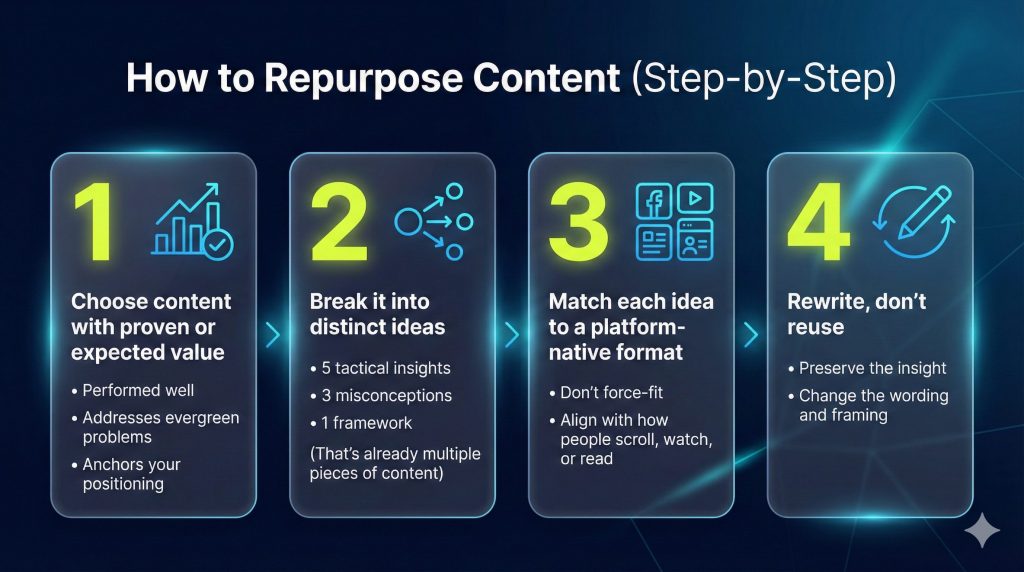
1. Choose content with a proven or expected value
Look for posts that:
- Performed well
- Address evergreen problems
- Anchor your positioning
2. Break it into distinct ideas
- 5 tactical insights
- 3 misconceptions
- 1 framework
… that’s already multiple pieces of content.
3. Match each idea to a platform-native format
Don’t force-fit. Choose formats that align with how people scroll, watch, or read.
4. Rewrite, don’t reuse
Preserve the insight, not the wording.
How to Repurpose Content for Different Platforms
Repurposing Blog Content
Blogs are one of the best core assets because they’re dense with structured thinking.
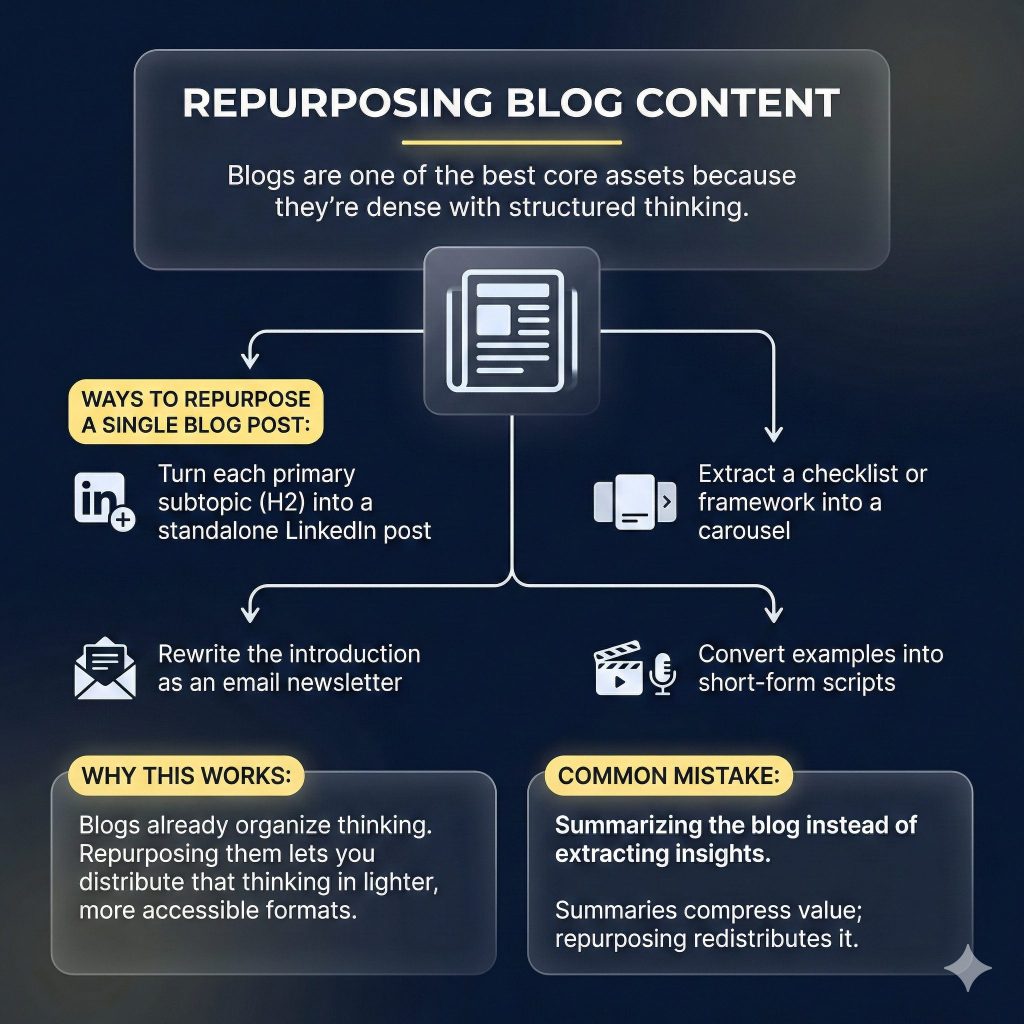
Ways to repurpose a single blog post:
- Turn each primary subtopic (H2) into a standalone LinkedIn post
- Extract a checklist or framework into a carousel
- Rewrite the introduction as an email newsletter
- Convert examples into short-form scripts
Why this works:
Blogs already organize thinking. Repurposing them lets you distribute that thinking in lighter, more accessible formats.
Common mistake:
Summarizing the blog instead of extracting insights. Summaries compress value; repurposing redistributes it.
Repurposing Content for Social Media
Social platforms reward clarity, specificity, and repetition—not completeness.
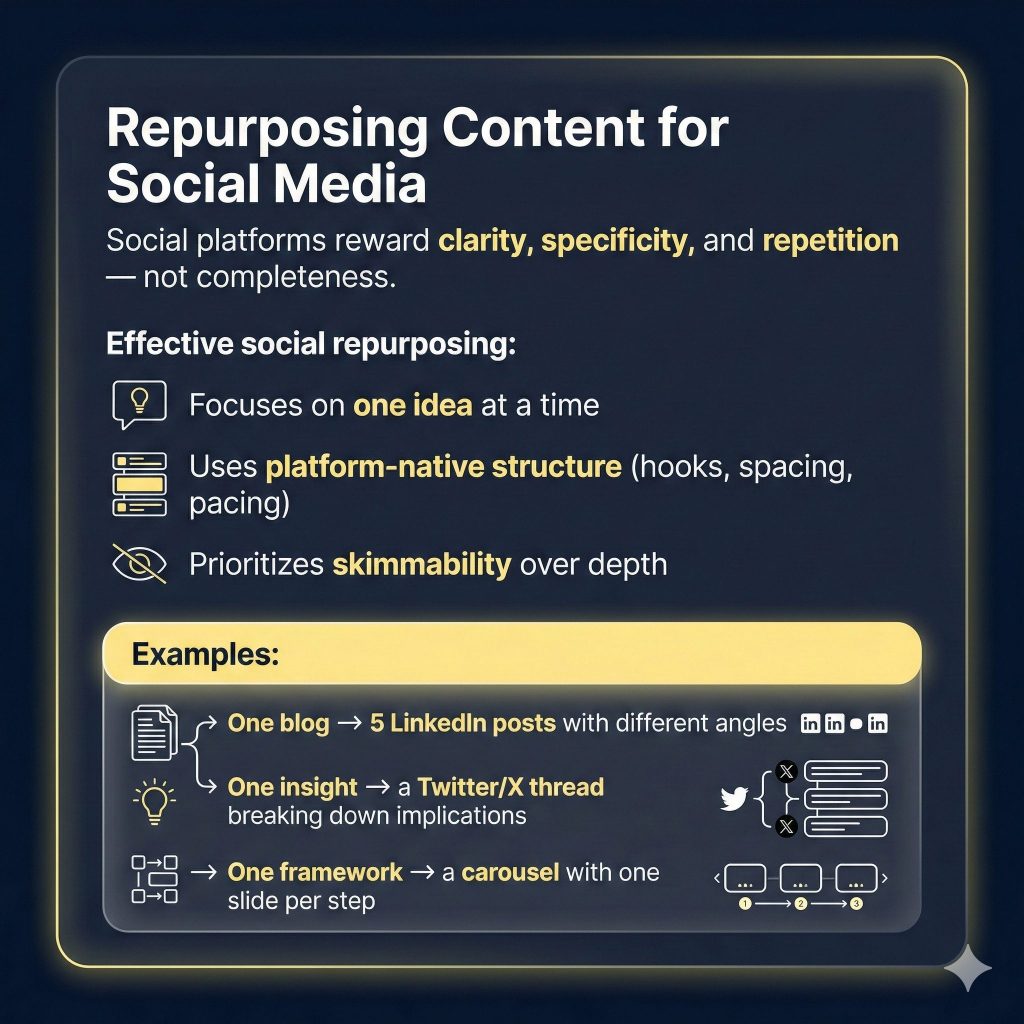
Effective social repurposing:
- Focuses on one idea at a time
- Uses platform-native structure (hooks, spacing, pacing)
- Prioritizes skimmability over depth
Examples:
- One blog → 5 LinkedIn posts with different angles
- One insight → a Twitter/X thread breaking down implications
- One framework → a carousel with one slide per step
Why this matters:
Social is discovery, not consumption. Your goal isn’t to teach everything–it’s to earn attention and curiosity
Repurposing Video Content
Video is one of the highest-effort formats, which makes it ideal for repurposing.
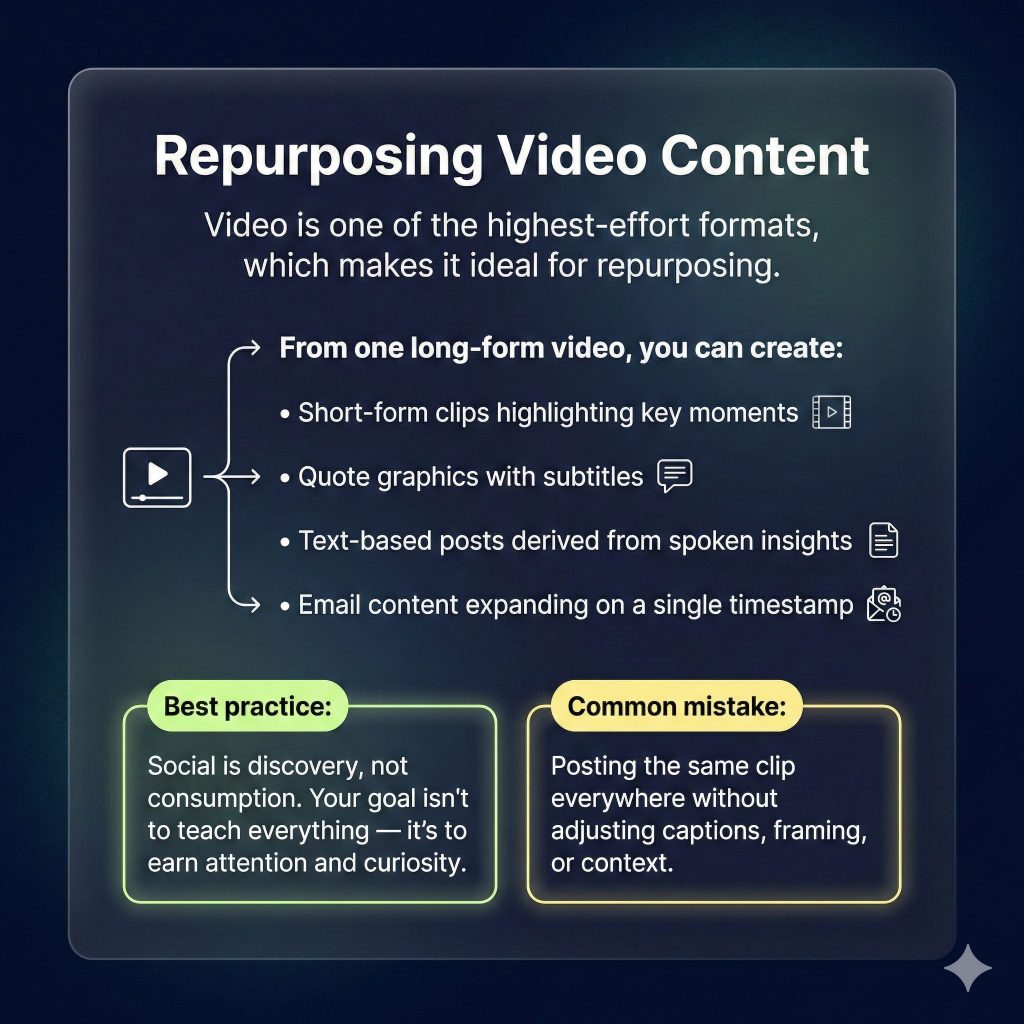
From one long-form video, you can create:
- Short-form clips highlighting key moments
- Quote graphics with subtitles
- Text-based posts derived from spoken insights
- Email content expanding on a single timestamp
Best practice:
Social is discovery, not consumption. Your goal isn’t to teach everything–it’s to earn attention and curiosity
Common mistake:
Posting the same clip everywhere without adjusting captions, framing, or context.
Repurposing Content for Email Marketing
Email is where repurposed content often drives the highest ROI—because it reaches an owned audience.
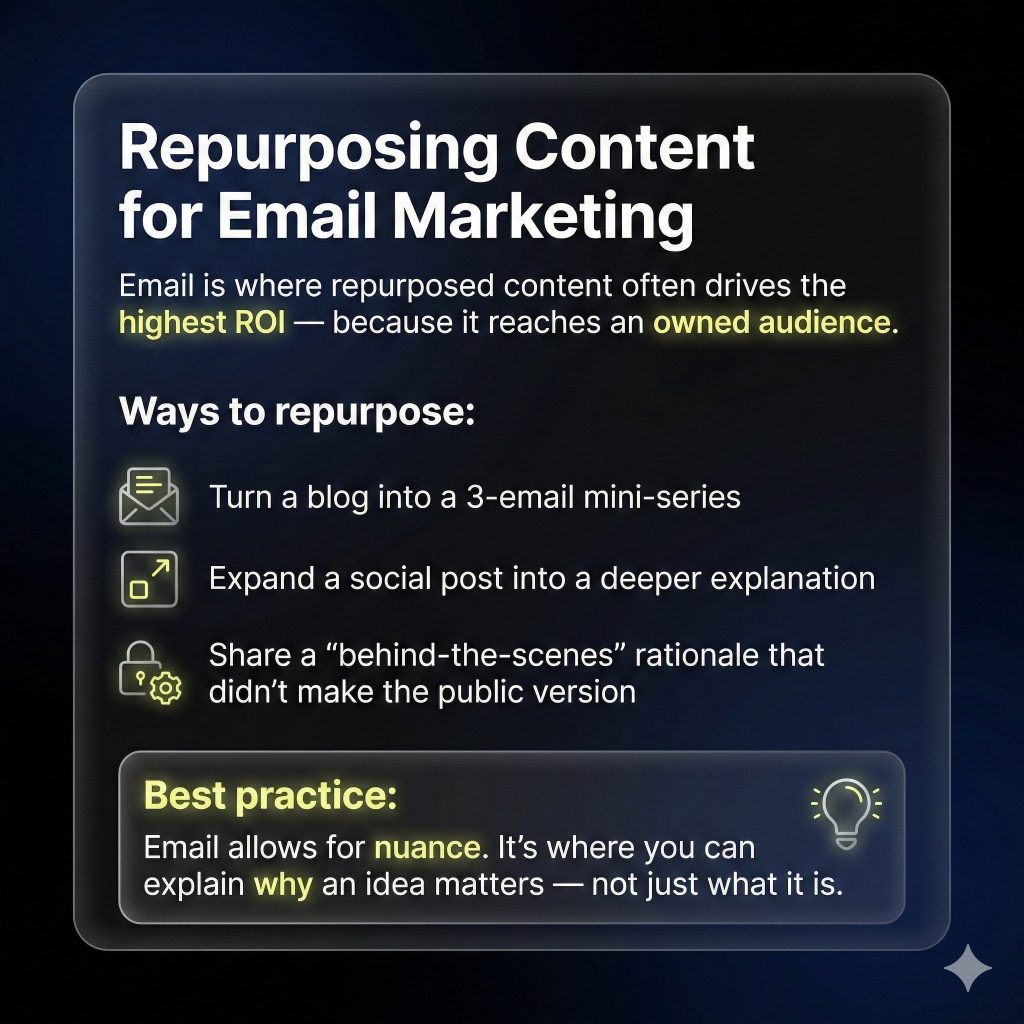
Ways to repurpose:
- Turn a blog into a 3-email mini-series
- Expand a social post into a deeper explanation
- Share a “behind-the-scenes” rationale that didn’t make the public version
Best practice:
Email allows for nuance. It’s where you can explain why an idea matters, not just what it is.
Real-World Outcomes: What Repurposing Changes
Teams that repurpose content well typically see:
- Higher engagement per idea
- Lower pressure to constantly create from scratch
- More consistent messaging across channels
- Better attribution across the funnel
One strong piece of content, when repurposed intentionally, can support:
- Awareness (social)
- Trust (email)
- Authority (blog or video)
- Conversion (sales enablement or nurture)
That’s leverage.
Common Misconceptions About Content Repurposing
“Repurposing is lazy.”
It’s only lazy if the transformation lacks intent. Strategic repurposing is editorial discipline.
“Our audience will get bored.”
Most people don’t see everything you publish. Repetition builds recognition—when reframed correctly.
“We need new content to grow.”
You need new ideas occasionally. You need better distribution constantly.
Final Takeaway: Repurposing Is a Strategic Skill, Not a Tactic
Content repurposing isn’t about doing more—it’s about getting more from what you already do.
When you design content with repurposing in mind:
- Creation becomes more intentional
- Distribution becomes more systematic
- Results become more predictable
For business owners, startups, and creators, this isn’t a nice-to-have. It’s how you scale presence without scaling chaos. If content is an investment, repurposing is how you compound it.
As Ross Simmonds says, “Create once, distribute forever.”